M for Coding is a coding assistant on NxtGen Cloud’s M generative AI platform, running Bud’s code-generation models and infrastructure. It is India’s alternative to Claude Code: the same multi-turn coding workflow, at a price a startup, an SME or a university department can carry.
Why India needs its own coding assistant
India is home to one of the world’s largest developer communities, boasting over six million developers across the country. A significant portion of this talent pool is concentrated in startups, small and medium-sized enterprises (SMEs), and academic institutions. These groups often operate under tight budget constraints, making cost one of the primary barriers to accessing advanced development tools. Despite their potential and innovation capabilities, many are unable to afford the licensing fees charged by global AI coding tools such as Copilot or Claude. That cost sensitivity creates a divide: the teams who can pay for frontier tooling gain a productivity edge, and the rest do not.
This disparity becomes even more concerning in the context of India’s broader national goals. Initiatives like Digital India and Atmanirbhar Bharat (self-reliant India) emphasize the need for homegrown solutions that can empower local developers and reduce dependency on expensive foreign technologies. An affordable, indigenous coding assistant would not only align with these national missions but also accelerate them by putting the same capability in the hands of every developer, whatever the budget.
Moreover, democratizing access to AI development tools is essential for fostering grassroots innovation. When students, hobbyists, and early-stage startups can experiment without financial barriers, they are more likely to innovate, iterate, and build solutions that address real-world problems. Affordability, in this context, isn’t just about saving money—it’s about unlocking creative potential at scale.
On a larger scale, enterprises and government bodies, which often manage large teams of developers, also stand to benefit significantly from cost-effective AI coding solutions. Reducing the per-user cost of AI tools can result in substantial savings, especially when deployed across hundreds or thousands of seats. More importantly, it can lead to faster development cycles, improved code quality, and accelerated digital transformation efforts within both public and private sectors.
In essence, the need for an affordable coding tool in India goes beyond economics—it is a strategic necessity. It represents an opportunity to empower millions, foster self-reliance, and fuel the next wave of digital innovation from the grassroots to the enterprise level.
Performance
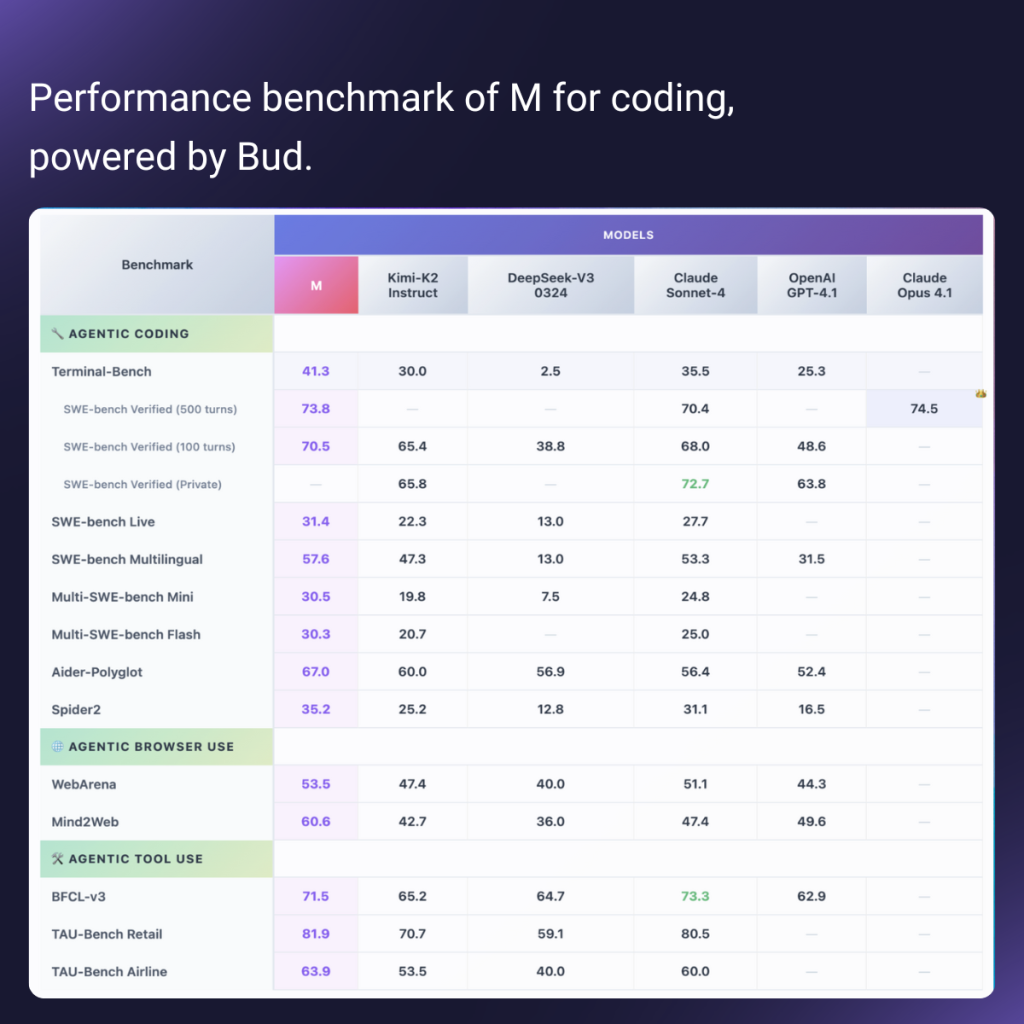
The benchmark provided below highlights M’s performance across three main categories: Agentic Coding, Agentic Browser Use, and Agentic Tool Use. Broadly, M consistently performs at or above parity with leading frontier models, excelling in multi-turn coding tasks, browser-based reasoning, and tool orchestration.
Agentic coding
M demonstrates strong coding abilities, especially in long-horizon reasoning tasks. M is optimized for sustained, multi-turn coding workflows, with performance clustered at the top end of benchmarks.
- SWE-bench Verified (500 turns): 73.8, ahead of Claude Sonnet-4 (70.4) and close to Claude Opus 4.1 (74.5). This positions M among the very top performers for multi-turn software engineering problems.
- SWE-bench Verified (100 turns): 70.5, outperforming OpenAI GPT-4.1 (48.6) and close to Claude Sonnet-4 (68.0).
- Aider-Polyglot: 67.0, ahead of every model in the comparison set, including Claude Sonnet-4 (56.4).
- Where the scores fall: live and flash challenges are harder for everyone — M scores 31.4 on SWE-bench Live and 30.3 on Multi-SWE-bench Flash. It still leads the comparison set on both.
Agentic browser use
M’s WebArena (53.5) and Mind2Web (60.6) scores are strong, consistently higher than OpenAI GPT-4.1 and Claude Sonnet-4. Both are web-based tasks against real page structure, which is what automation and research agents actually run against.
Agentic tool use
Tool coordination is where the margins are widest. That matters for automation workflows in which several APIs and tools have to be sequenced in one task.
- BFCL-v3: 71.5, ahead of GPT-4.1 (62.9) and competitive with Claude Sonnet-4 (73.3).
- TAU-Bench Retail: 81.9, surpassing all peers, with a margin over Claude Sonnet-4 (80.5).
- TAU-Bench Airline: 63.9, ahead of Claude Sonnet-4 (60.0).
How it compares
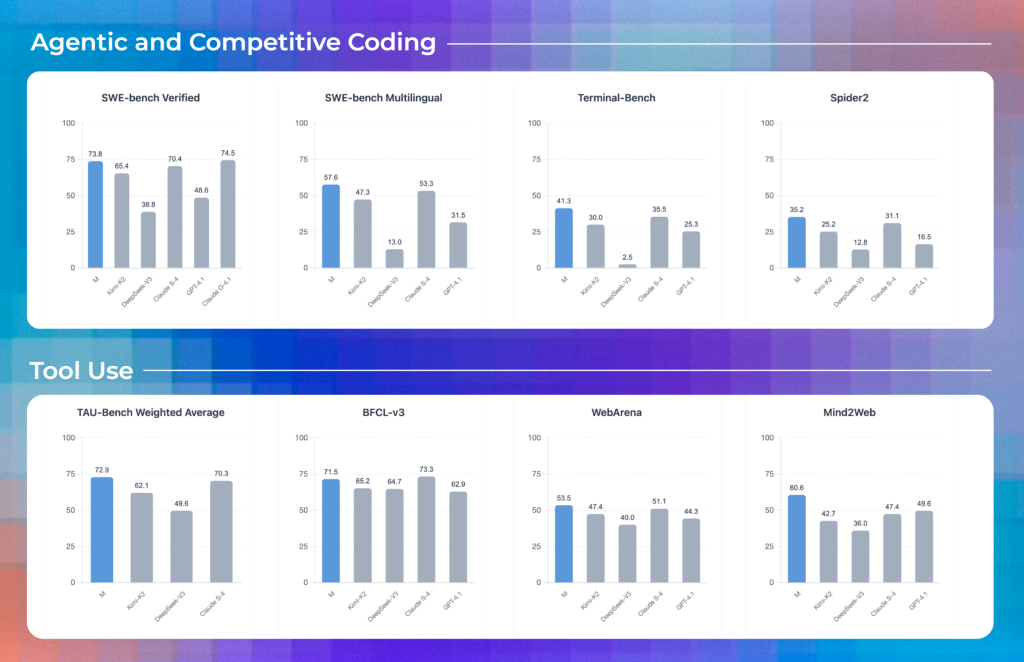
M establishes itself as a frontier-grade coding and agentic model, excelling in multi-turn software engineering, web reasoning, and tool orchestration. Its standout strength is in long-horizon coding benchmarks (SWE-bench 500) and real-world tool use (TAU-Bench, BFCL), where it leads or ties with the very best.
That places M as a generalist agent model whose strongest results are in automation workflows — coding agents, browser-integrated assistants, and tool-driven systems that run without a human in each step.
- Against Claude Sonnet-4 & Opus 4.1: M is often on par or slightly stronger, particularly in tool use and long-horizon coding. Opus edges ahead slightly in certain SWE-bench subsets, but M is consistently competitive.
- Against GPT-4.1: M clearly outperforms GPT-4.1 across almost all benchmarks, especially in coding and tool integration.
- Against DeepSeek & Kimi-K2: M shows a substantial lead, particularly in complex reasoning and agentic tasks, suggesting it belongs in the frontier model tier.
Benchmark figures are NxtGen and Bud’s own measurements, taken in September 2025 against the published checkpoints of each comparison model. Every score quoted in the prose is read from the table above; where a model has no published result for a benchmark the cell is left empty rather than counted as zero.