
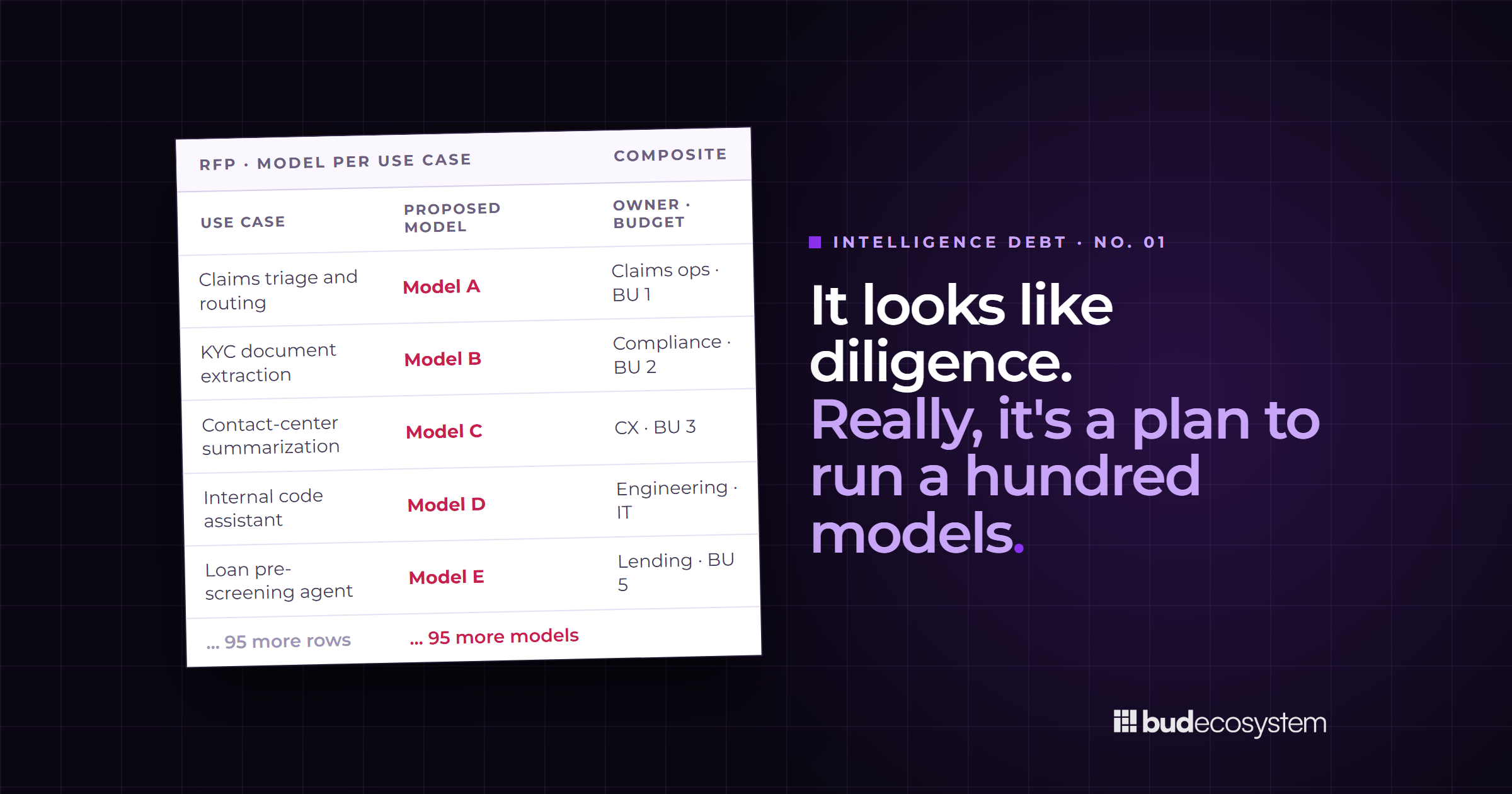
There is a spreadsheet we see almost every week. An RFP comes in with a hundred AI use cases down one column and a blank column next to it asking us to name a model for each. Every row has its own owner, its own budget, its own vendor. It looks like diligence. Really, it is a plan to run a hundred models, and nobody in the building has noticed yet.
That spreadsheet is why every enterprise I talk to is running less intelligence than it could. Not because the models are not available. Because of how the models got there.
We have a name for the gap. We call it Intelligence Debt, and this post is about what it is and why you should care, before the full article gets into the numbers.
What it is
Intelligence Debt is the gap between the capability your enterprise could deliver with the best available models and the capability it actually delivers with the models it runs, plus the cost of closing that gap.
It behaves like technical debt. You take it on one reasonable decision at a time. It accrues interest. And it is invisible on the P&L until the day it is not.
It is paid in two currencies. The first is money: the fixed cost of every model you keep alive that a governed portfolio would not need. The second is capability: the work your use cases could be doing on this quarter's model while they are still running on the one they were pinned to two years ago.
Where it comes from
Several things accrue Intelligence Debt. Evaluation that does not exist. Data that is not ready for AI. Infrastructure that cannot be left. We will take those up in later articles.
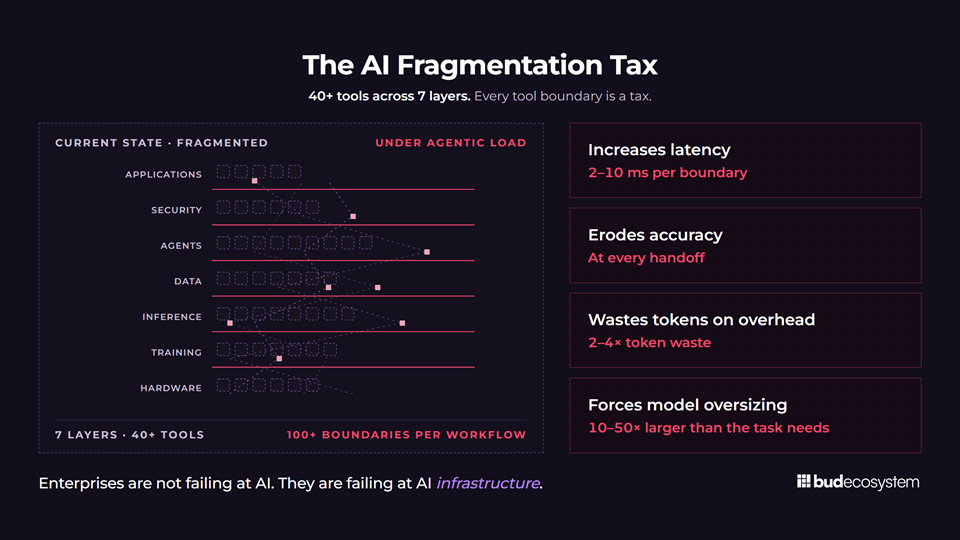
The largest contributor, and the one we see most often from the RFP desk, is model fragmentation.
Go back to that spreadsheet. Nobody decides to run a hundred models. It happens one rational decision at a time, on different floors of the same building. The business unit funding the fourth claims model has never heard of the first three. Security, legal and model risk review each model on its own, because that is how the process is written. The use case ships with prompts tuned to that model, which makes leaving it expensive. Then the next floor starts.
The aggregate is nobody's job until it is everybody's problem. And the aggregate is where the debt lives.
Why you should care
Three reasons.
- It costs about two and a half times as much. Every model in a regulated enterprise must be selected, security-reviewed, validated, cleared by legal, integrated, guarded, evaluated, monitored and hosted, then put through most of that again at every vendor version. In a one-model-per-use-case estate that is paid once per use case. In a governed portfolio it is paid once per role. Our five-year model of a mid-sized regulated enterprise comes out at $171.6M fragmented against $68.2M governed, serving the same use cases. The gap widens every year.
- Your estate ages a year every day. Frontier models double the length of task they can complete roughly every seven months. A model pinned at admission keeps admission-day capability. Two thirds of teams never switch providers because the prompts were tuned to the model they have. The use case still works. It just works like 2025. In our model, deferring refresh leaves $20.2M of unpaid migrations on the books by year five, on models two generations behind.
- Agents make it worse. Gartner expects 150,000 agents per Fortune 500 enterprise by 2028. Agents need one consistent model layer underneath them. A hundred siloed integrations cannot host them, and the regulators asking for inventories, concentration limits and tested exit plans are asking for things that get harder with every model you add.
What to do about it
The fix is not a better model. It is a different unit of decision. Stop choosing models for use cases and start filling roles for the enterprise: frontier reasoning, general workhorse, small and fast, plus a specialist tier of six to ten. The model behind each role is whatever is best this quarter, and it changes behind the router without any use case noticing.
That takes one organization-level AI strategy with three parts: a model strategy owned by a portfolio board, a platform strategy owned by a platform team, and deliberately limited business-unit strategies that own use cases and outcomes but never select, host or contract for a model.
If you want to start on Monday, three things.
- Count the models, including the ones nobody approved. Most enterprises are surprised by the number.
- Put one gateway in front of all of it before changing anything else. Visibility first, decisions second.
- Give every production use case an evaluation set, because without one there is no migration, routing or upgrade, only opinions.
If you have the use-case list from your RFP, send it to us. We will return it as a role map: which three core models would carry it, which specialists it needs, and the five-year bill both ways, on your numbers.
The five-year figures come from the synthetic total-cost-of-ownership model in the featured article: a regulated enterprise growing from 60 to 140 generative AI use cases, the fragmented estate admitting roughly one model per 1.4 use cases, the portfolio holding three core roles and a specialist tier that settles at 13. The assumptions are listed on page 06 of the article; replace them with your own and the shape survives. Frontier pace: METR 2025 (task-horizon doubling of roughly seven months). Provider switching: Menlo Ventures 2025 (66% upgraded within their provider). Agent count: Gartner (150,000 agents per Fortune 500 enterprise by 2028). RFP figures are a composite of the enterprise and government RFPs Bud has answered since 2025, rounded.
 Kevin Johnson