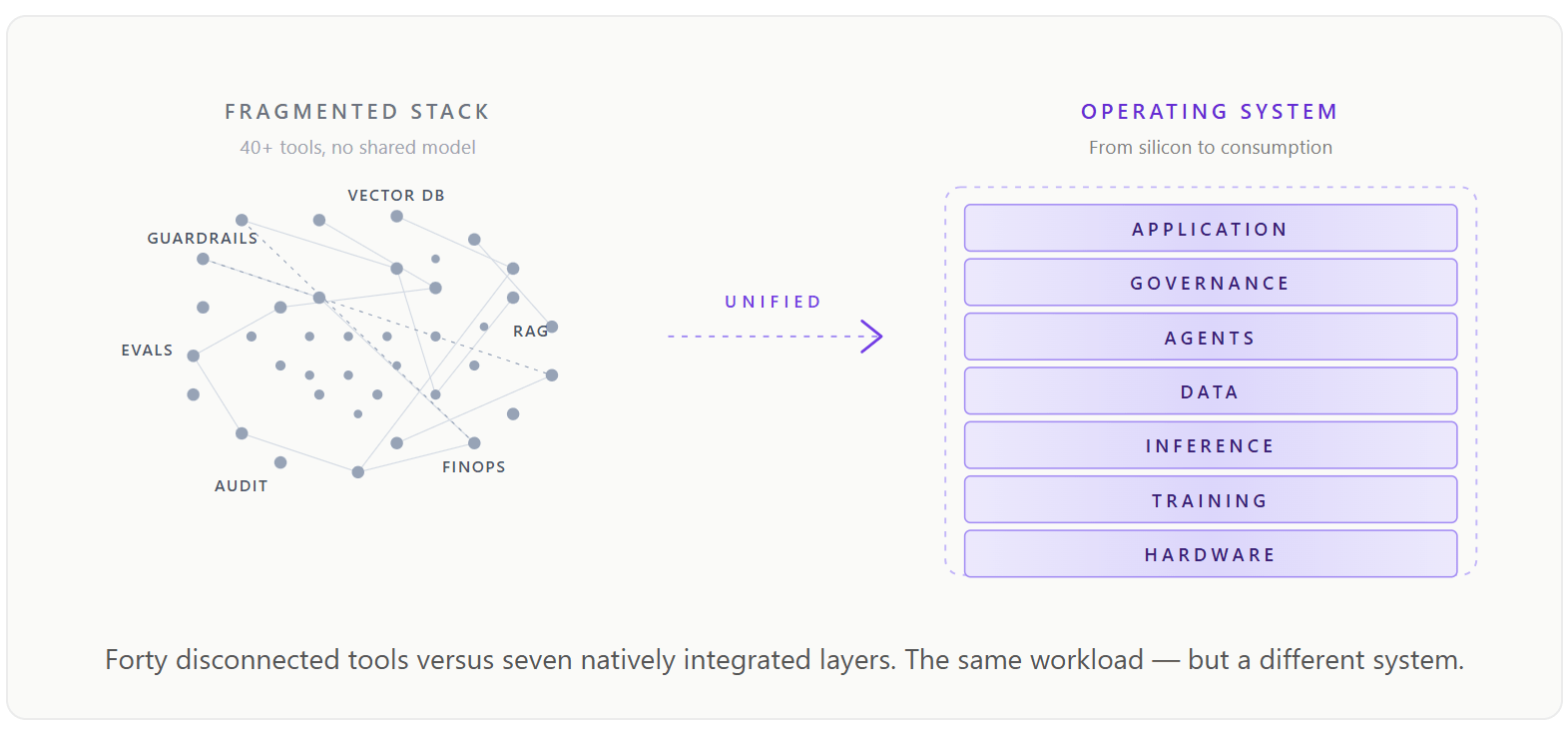
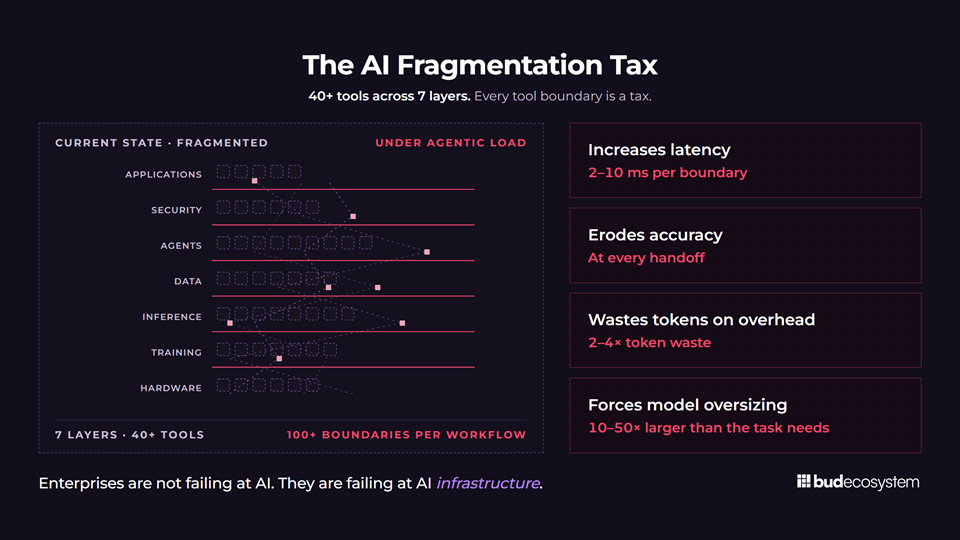
A promising AI pilot can conceal a hard enterprise problem: uniformity, trust, and scale. One team has an assistant that answers questions. Another needs an agent to update records. A third must keep sensitive data in a private environment. Each can work on its own, yet the organization may still lack a consistent way to deploy models, enforce permissions, measure quality and account for cost.
An enterprise AI operating system should provide that shared operating layer across models, infrastructure, applications and agents. It must also work with existing identity, data and security systems. The purchasing question is practical: can this platform help more project teams reach production with acceptable quality, cost and control? Evaluate it against workloads in your own environment, not a vendor demonstration alone.
Business fit and measurable outcomes
Choose two representative workflows before comparing platforms. One might process a high volume of routine service requests; another might let an agent prepare a regulated case for human approval. Define the current cost, cycle time, error rate and review effort. Then set minimum quality and safety (guardrails) requirements. A model that answers quickly but adds substantial human rework has not improved the workflow.
The complete path from input to accepted outcome, including exceptions, handoffs and the business metric that an owner will monitor after launch.
Economics at the level of a completed task
Token price is a useful input, but a weak measure of value. Include model usage, hosting, retrieval, integration, support, failed attempts and human review in the cost calculation. Compare cost per accepted case or resolved request at realistic volumes and peak demand. The FinOps Foundation recommends moving from resource measures such as cost per token toward business measures such as cost per case resolved. [1]
Usage by team and workflow, a full cost breakdown, limits that prevent runaway consumption, and how routing to a smaller or private model affects quality as well as price.
Governance that works during execution
Check who can call each model, what data an agent can retrieve and which actions require approval. Test a tool request that should be permitted and one that should be blocked. Inspect the trace: can an auditor reconstruct the model, input source, policy decision, tool call, human approval and output? NIST’s generative AI guidance emphasizes risk measurement and evaluation across the system lifecycle. [2]
A live denied action, an escalation to a human, policy changes across teams and the audit evidence produced without manual reconstruction.
Portability across models and infrastructure
A platform should let the enterprise change models or deployment locations without rebuilding every application. Move the same workload between two approved model backends, including a private endpoint if your requirements call for one. Check whether identity, routing rules, evaluations and telemetry still apply. Confirm where prompts, weights, logs and backups reside, and what it takes to leave or change providers.
The code changes, policy changes, downtime and operational work required for that switch. A familiar API format is helpful, but it does not by itself establish portability.
Production operations and model quality
Measure response time at the 95th percentile under normal load and bursts, rather than relying on a best-case response. Examine scaling, failure handling, monitoring, incident ownership and rollback. Require a versioned evaluation set for accuracy, grounded answers, safety and workflow completion. A change in model or prompt should be tested against the same acceptance criteria before promotion to production.
A failed deployment, an alert, the on-call view and a return to the last approved version. Identify which team owns each step once the pilot ends.
Integration and time to value
A platform earns its place when application teams can use existing systems with fewer bespoke connections. Test your identity provider, one authoritative data source, one business application and the interface your developers already use. For agents, verify that tool access respects user and service permissions; a large connector catalog is no substitute for tested access controls.
The actual integration effort, the work that remains with your team and the support model for updates to a connected system.
Use a weighted scorecard
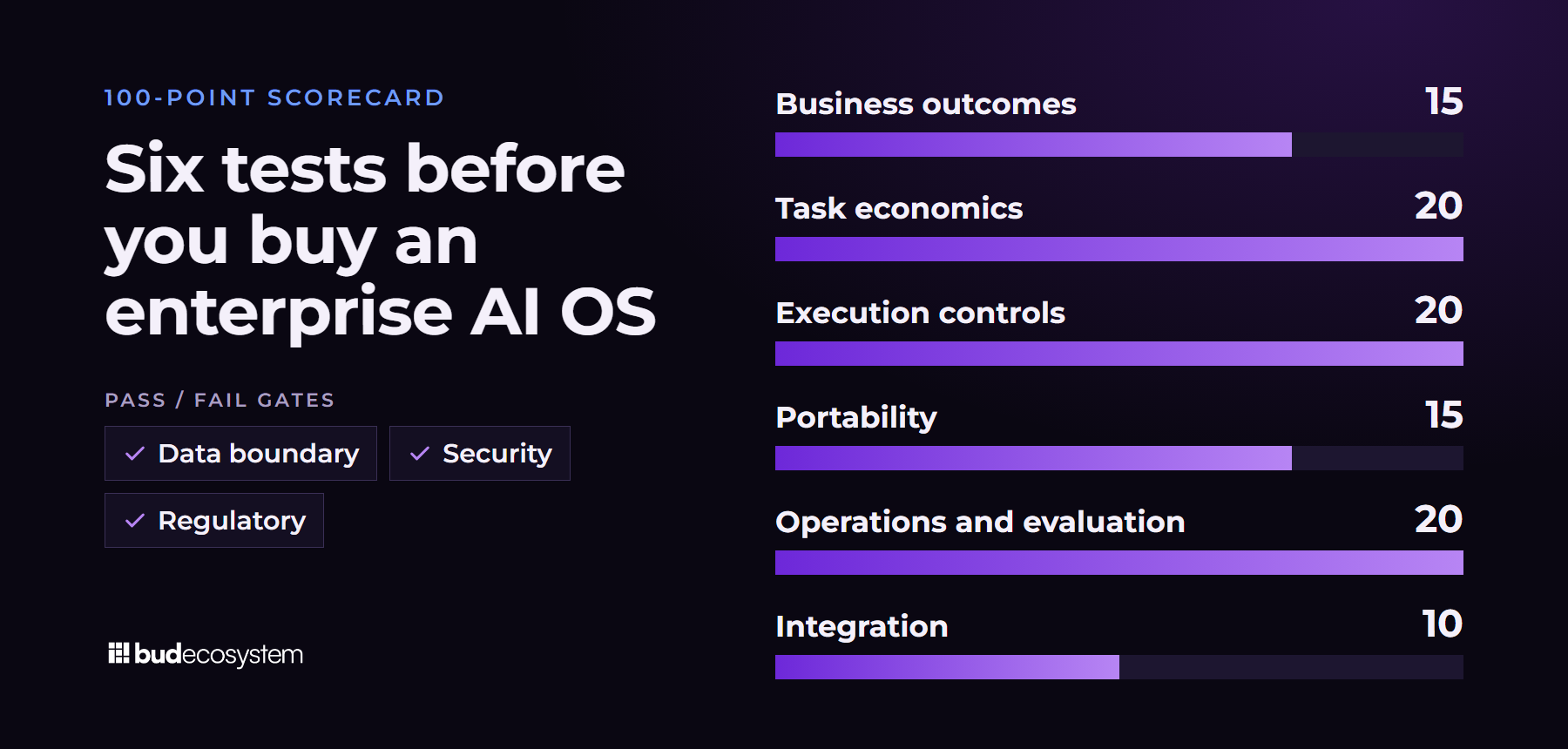
Agree on weights before seeing product demonstrations. Score each category from 0 to 5 using evidence from your workload; calculate weighted points as weight × score ÷ 5. The example below totals 100 points. Make data-boundary, security and regulatory requirements pass/fail gates so a high average cannot excuse a critical failure.
| Decision area | Weight | Evidence to request |
|---|---|---|
| Business outcomes | 15 | Accepted tasks, rework and cycle time |
| Task economics | 20 | Fully loaded cost per accepted task |
| Execution controls | 20 | Permitted and blocked actions with audit trail |
| Portability | 15 | Switching model and deployment location |
| Operations and evaluation | 20 | p95 latency, monitoring, rollback and quality |
| Integration | 10 | Working connections and implementation effort |
| Total | 100 | Data-boundary, security and regulatory requirements are pass/fail gates, not weights |
Table 1 — an example weighting; agree your own before the first demonstration
Prove the decision on your own workload
Run a bounded proof of value with the same input set, acceptance rules and traffic pattern used for the current approach. Record cost per accepted task, p95 latency, exceptions, reviewer minutes, blocked actions and trace completeness. Document what each vendor configured, what your team built and what would have to change before production. The strongest result is a repeatable comparison that a business group owner, security lead, and architect can each inspect.
There is an answer available. Bud Novaria, the enterprise AI operating system, brings together model development, serving, evaluation, guardrails, agent tools and infrastructure management in one enterprise AI stack. A key part of the stack, Bud AI Foundry offers cloud and on-prem deployment, model routing, OpenAI-compatible APIs, governance and observability. [3] [4] Those capabilities deserve the same tests above. Bring Bud a real workflow, a cost baseline and your control requirements; we can assess whether the Bud Novaria platform improves the outcome in your environment. We are confident that it will.
Your workflow, your cost baseline and your control requirements, tested against the six areas above.
Sources: [1] FinOps Foundation, Unit Economics. [2] NIST, AI Risk Management Framework: Generative AI Profile. [3] Bud Ecosystem, Bud Novaria enterprise AI operating system. [4] Bud Ecosystem, Introduction to Bud AI Foundry. The scorecard weights are an example, not a benchmark; set your own.
 Kevin Johnson
 Rob Rollinger