India, being one of the most linguistically diverse nations in the world, faces a major roadblock in harnessing the full potential of generative AI. With only about 10% of the population fluent in English, the remaining 90% are effectively left behind—unable to engage with generative AI tools that are predominantly built for English-speaking users.
Most leading language models today are trained using the English language, offering little to no support for Indian languages. As a result, the depth and richness of India’s linguistic and cultural heritage are being overlooked by this global AI wave—leaving billions underserved and underrepresented. To address this gap, we need language models that are;
- Proficient in Indic languages
- Open-source, making it available to researchers, developers, and the public
- Offers a commercial license, allowing businesses to freely build applications, tools, and services without restrictive usage terms
Hex1: Indic LLM Built for India Hex1 is a 4-billion parameter language model specifically optimized for Indian languages. It is designed to bridge the linguistic AI gap in India by enabling developers to build intelligent systems that understand and respond in native Indian languages. In its first release, Hex1 supports five major Indian languages, including Hindi, Kannada, Telugu, Tamil and Malayalam. Future versions of the model are set to expand support to more languages, broadening its usability across the Indian subcontinent.
When benchmarked against leading models like Gemma-2B, LLaMA-3.2-3B, and Sarvam-1, Hex1 posts the highest MMLU score of the models compared, in all five supported languages. This makes it one of the most capable models currently available for Indic language tasks.
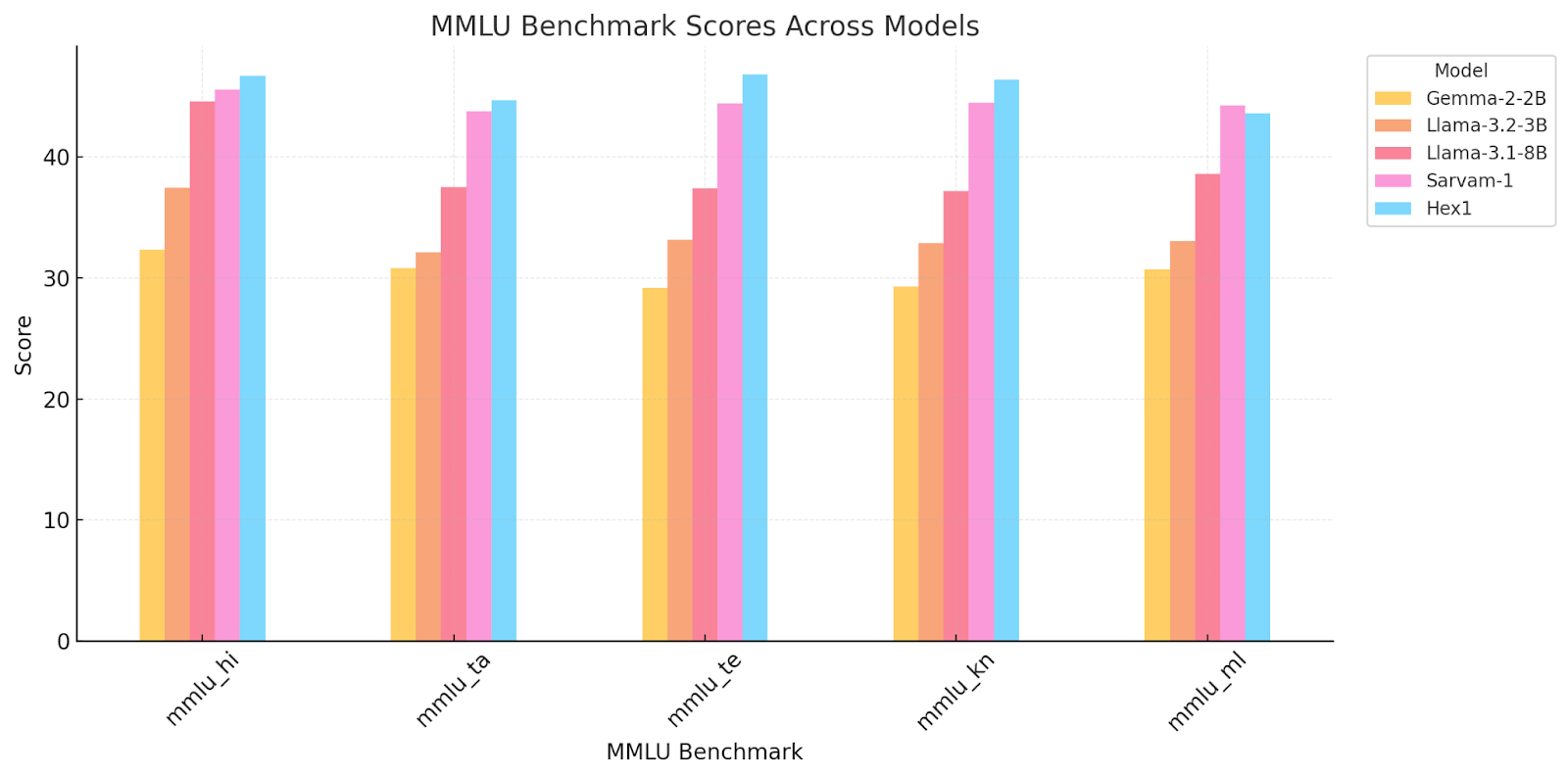
Hex1 is released under an open-source license that includes commercial usage rights, a rare and valuable combination. This means that anyone—from independent developers to startups and large enterprises—can freely use the model to build products tailored to the Indian market.
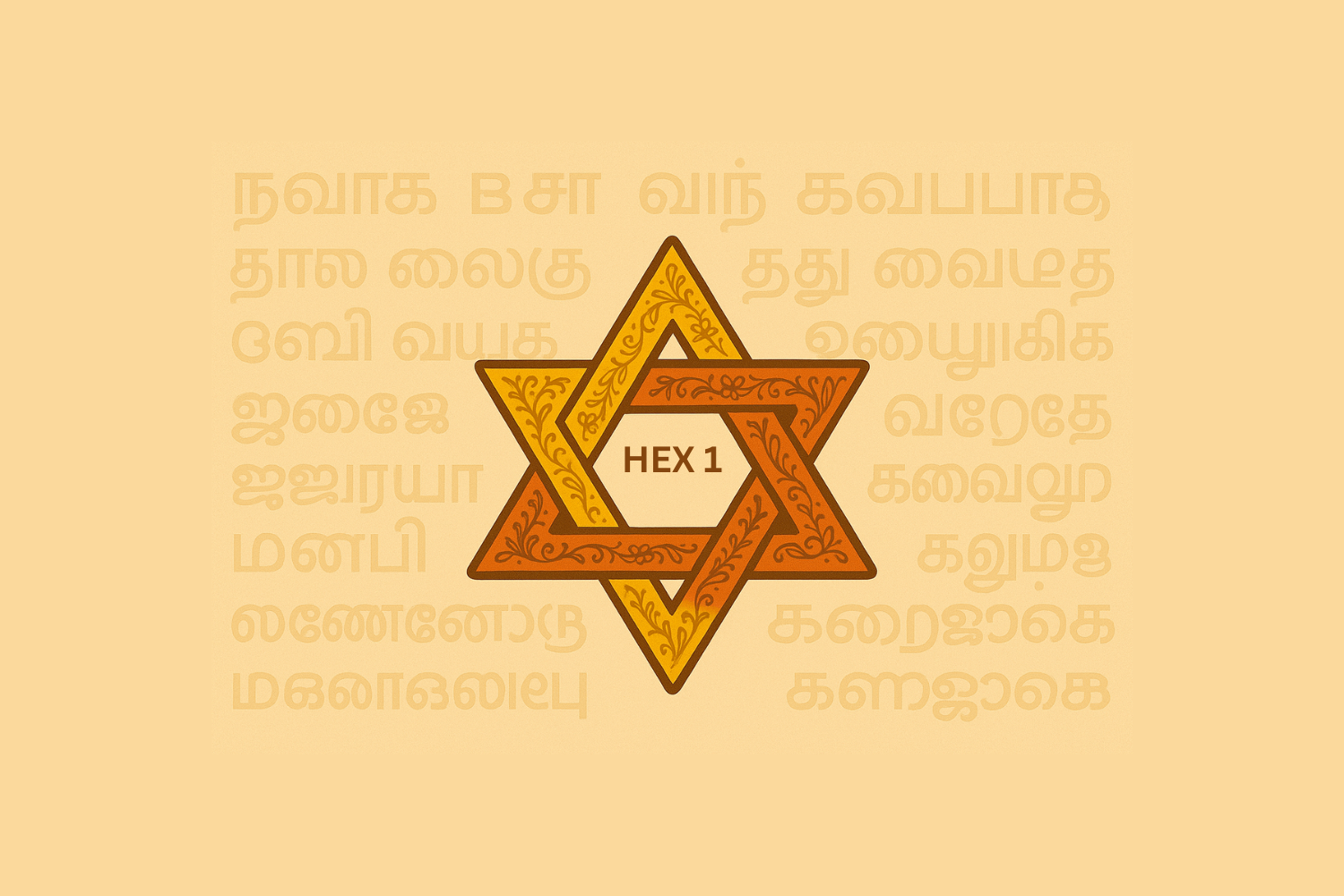
The Vision Behind Hex Hex1 is just the beginning. It is the first model in the Hex series of LLMs dedicated to Indic languages. The name Hex draws inspiration from the hexagram, a six-pointed geometric figure that symbolizes cultural symmetry and unity in diversity—perfectly capturing the essence of India’s multilingual identity. By open sourcing Hex1, we aims to empower a new generation of AI models that are rooted in India’s linguistic and cultural realities, helping ensure that the generative AI revolution truly reaches every corner of the country.
Appendix: benchmark results
Performance of Hex-1 Across Indic Languages and Evaluation Benchmarks
| HEX-1 | Hellaswag | ARC-c | ARC-e | MMLU | BoolQ |
|---|---|---|---|---|---|
| Hindi | 47.85 | 36.68 | 52.14 | 46.73 | 57.61 |
| Tamil | 49.45 | 38.65 | 53.45 | 44.71 | 45.87 |
| Telugu | 50.84 | 37.96 | 53.36 | 46.85 | 51.89 |
| Kannada | 52.16 | 38.31 | 53.11 | 46.38 | 52.32 |
| Malayalam | 46.32 | 29.60 | 40.86 | 43.63 | 46.69 |
Performance comparison of Hex-1 with different models on MMLU dataset
| Benchmark | Gemma-2-2B | Llama-3.2-3B | Llama-3.1-8B | Sarvam-1 | Hex1 |
|---|---|---|---|---|---|
| mmlu_hi | 32.35 | 37.44 | 44.58 | 45.58 | 46.73 |
| mmlu_ta | 30.82 | 32.14 | 37.50 | 43.79 | 44.71 |
| mmlu_te | 29.20 | 33.15 | 37.43 | 44.43 | 46.85 |
| mmlu_kn | 29.29 | 32.90 | 37.22 | 44.50 | 46.38 |
| mmlu_ml | 30.71 | 33.04 | 38.60 | 44.25 | 43.63 |
Performance comparison of Hex-1 with different models on ARC-C dataset
| Benchmark | Gemma-2-2B | Llama-3.2-3B | Llama-3.1-8B | Sarvam-1 | Hex1 |
|---|---|---|---|---|---|
| arcc_hi | 37.57 | 49.13 | 56.17 | 60.00 | 36.68 |
| arcc_ta | 32.78 | 34.7 | 44.78 | 57.04 | 38.65 |
| arcc_te | 30 | 34.09 | 43.04 | 59.39 | 37.96 |
| arcc_kn | 29.22 | 36.43 | 44.7 | 57.04 | 38.31 |
| arcc_ml | 29.91 | 33.22 | 46.78 | 58.96 | 29.60 |