
For the first time in my working life, the future we were promised is arriving on schedule.
AI drafts my first versions, reads the documents I don't have time for, writes the code I would have spent an afternoon on, and checks my work before anyone else sees it. It does not replace the people I work with. It works alongside us, and we get more done. I use it every day, so does almost everyone I know, and so does nearly every organisation we talk to at Bud.
It is all good until I ask one question: how long can this last?
Look at where that AI comes from. For individuals and organisations alike, almost all of it is rented from a handful of companies: Google, OpenAI, Microsoft, Anthropic, xAI. You can count the providers that matter on one hand. That should worry us more than it does.
The price we pay today is not the price of AI
It is the price of market share. The frontier labs are raising and spending capital at a scale the technology industry has not seen before, and they are pricing for growth, not margin. Generous plans, cheap tokens and near-unlimited usage are how you win a market. They are not how you run one.
We have watched this film before. Ride-hailing fares were subsidised by venture money until the competition thinned out, and then they rose. Streaming replaced the cable bill with one cheap subscription, and then came the price rises, the ad tiers and the password crackdowns. Cloud made it free to bring your data in and expensive to take it out. The pattern is always the same: subsidise, consolidate, then charge. And the customer who built their habits on the subsidised price pays the bill.
AI will follow the same pattern, but the stakes are higher. This time we are not handing over our commute or our evenings. We are moving workflows, institutional knowledge and customer data into somebody else's system. The first signs are already here: usage caps on the most popular plans, rate limits that bite at the busiest hour, and premium tiers priced for people who can no longer work without them. The days of unlimited tokens are numbered. As the field narrows, things will get expensive.
A word for it
I kept reaching for a word to describe this and couldn't find one that fit. So here is mine.
fewopoly /fjuːˈɒp.ə.li/ noun
A global market served by so few providers that it behaves like a monopoly. Prices, terms and access are set by a handful of companies, and the customer has nowhere else to go.
From few + -opoly, after monopoly and oligopoly.
Economists will say there is already a word for this: oligopoly. There is, and it is not quite right. An oligopoly is a market with a few sellers, such as the airlines on one route or the cement makers in one region. Customers in an oligopoly still have a way out. Fly a different route, import from the next region, wait for a new entrant. A fewopoly is an oligopoly with no outside. The market is global, the same five providers serve everyone everywhere, and the cost of switching is not a plane ticket. It is your workflows, your integrations and your data. When the whole world buys from the same handful of companies, a handful is functionally one.
Nobody has to sign anything for this to work. I am not accusing anyone of collusion. I am describing a structure. In a market of a few, prices converge by observation: each provider watches the others, nobody undercuts for long, and the way AI is billed, per seat, per token or per agent-hour, becomes an industry standard set by the people selling it.
Price is only part of it. A fewopoly also decides what the model will and will not do, which data it retains, which countries get access, and when the model your product depends on is retired. Those are not pricing decisions. They are decisions about control, and right now almost none of them sit with the customer.
The counterweight is already here
There is good news, and it comes from the open-source community. Open-weight models from DeepSeek, Qwen, Meta, Mistral, Moonshot and others, including OpenAI's own open releases, have closed most of the gap with the frontier. On most of the work a business actually does, such as extraction, summarisation, classification, drafting, code and multi-step reasoning, an open model you can download and run on your own hardware is now good enough. Often it is better, once it has been tuned on your own data.
So why hasn't that dented the fewopoly? Why does nearly every enterprise AI project I hear about still start with a frontier API key?
Because a model is not enough.
What the fewopolists actually sell
When you use a frontier assistant, the model is the smallest part of what you are buying. You are buying a system:
- Agents and a harness. The loop that plans, calls tools, checks its own work and tries again when a step fails.
- Tools and connectors. Browsing, code execution, file handling, and access to your email, calendar, drive and business apps.
- Memory and context. Retrieval, long-context management, and projects that remember what you were doing last week.
- Guardrails. Input and output filtering, policy enforcement and abuse detection, running on every request.
- Observability and evaluation. Tracing, logging and regression testing, so a new release does not quietly break yesterday's behaviour.
- Serving at scale. Routing, caching, batching and autoscaling that keep latency low when millions of people arrive at once.
- Identity, access and compliance. Who can use what, who saw which data, and the audit trail that proves it.
- Training for action. Models post-trained not just to generate text but to get things done: operate a codebase, use a computer, edit a video, answer a phone call.
Open weights give you the engine. The fewopolists sell the car, the roads, the fuel network and the mechanic. Most organisations do not want an engine. They want to get somewhere.
Building it yourself is the trap
So an organisation that wants an equivalent system of its own faces a multi-year, multi-million-dollar project. It needs inference engineers, platform engineers, security specialists, evaluation specialists and people who have run GPUs in production. It needs them in a market that does not have enough AI talent, while competing for those same people with the fewopolists themselves, who can outbid almost anyone.
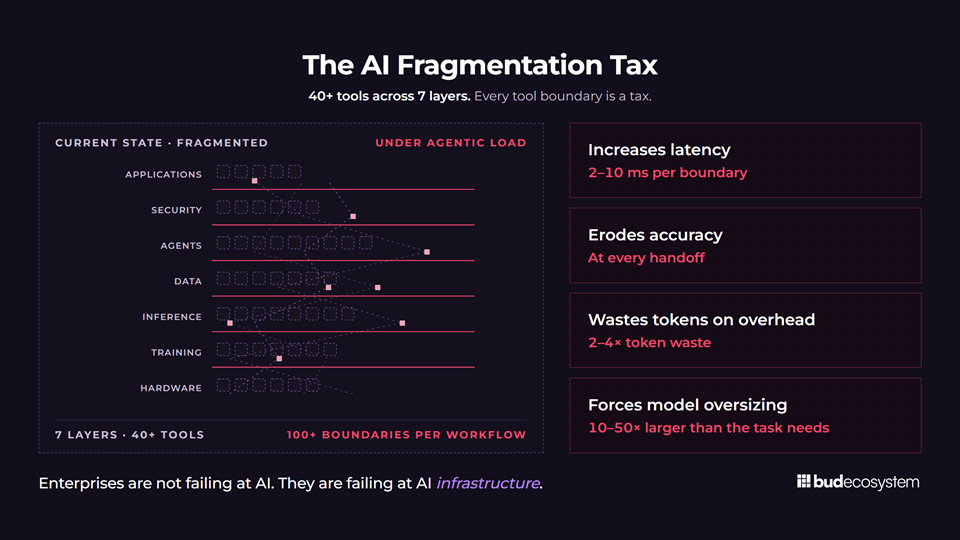
What usually happens instead is assembly. A serving engine from one project, a vector database from another, an orchestration framework, a gateway, a guardrail service, an observability vendor, a cost dashboard. By Bud's reference-architecture count, full production capability takes more than 40 tools across seven layers. Every tool is good. The problem is the boundaries between them.
Every boundary charges a toll in latency, accuracy, tokens and auditability. Chain five steps that are each 95% reliable and the workflow is right 77% of the time. Re-serialise context at every handoff and a large share of your token spend goes on overhead instead of answers. We call this the AI Fragmentation Tax, and it is a big part of why so many pilots never reach production.
The fewopoly does not win on merit. It wins by default, every time an organisation tries to build the system itself and gives up.
The project stalls, someone concludes that open source "isn't ready", and the team goes back to the API. Not because the open models failed, but because nothing held them together.
What owning the system buys you
Now imagine the other outcome. An organisation runs its own equivalent of a frontier AI system, built on open models, on infrastructure it controls. Here is what changes:
- Control. You decide which model runs, when it changes and what it is allowed to do. Nobody retires the model under your product on someone else's schedule.
- Predictable economics. You pay a unit cost per task, on hardware you own or choose, instead of following a price list that someone else revises.
- Sovereignty. Prompts, documents and customer records never leave your perimeter, which matters even more in regulated industries and in countries that cannot accept foreign jurisdiction over their data.
- Lower concentration risk. An outage, a policy change, an export restriction or a suspended account at one vendor does not stop your business.
- An asset that compounds. A model tuned on your workflows becomes intellectual property you own, not an improvement you donate to your provider's next release.
- Hardware freedom. You run on the silicon you can get, and you are not tied to a single chip vendor's roadmap and allocation queue.
- Auditability. Every request, decision and data access is traceable end to end, which is increasingly what regulators expect.
What we are building at Bud
That is the outcome we are building towards at Bud Ecosystem, with the Bud Novaria AI OS. It is not another model, and not another tool for the pile. It is the system around the model, delivered as one platform that an organisation runs on its own infrastructure: on-prem, in any cloud, or fully air-gapped.
Novaria is eight natively integrated layers under one control plane, numbered from the silicon up. Each part of the system the fewopolists sell has a home in it:
| What you rent from a fewopolist | Where it lives in Novaria |
|---|---|
| Agents and the harness | 08 Bud Agent, an enterprise agent with guardrails, observability and audit built in, and 07 Bud Studio, with 60+ pre-built agents. |
| Tools and connectors | 05 Bud MCP Foundry, which turns existing enterprise software, APIs and workflows into secure, federated MCP servers. |
| Guardrails, access and compliance | 06 Bud SENTRY, which provides zero-trust security, custom guardrails, RBAC, FinOps controls and compliance monitoring at runtime. |
| Serving, memory, observability and evals | 04 Bud AI Foundry, one stack for multi-modal inference, scaling, evaluation, memory and tools, for open and closed models alike. |
| Training for action | 03 Bud Model Foundry, which trains across 120+ architectures, including agentic training on your own production signal. |
| Infrastructure | 02 Bud Pod, a private GPU-as-a-service, and 01 Bud LayerZero, which abstracts 600+ hardware types across NVIDIA, AMD, Intel and Qualcomm. |
Table 1 — the system a frontier assistant sells, mapped to the Bud Novaria AI OS
Because every layer shares one data, security and compliance plane, there are no boundaries for the Fragmentation Tax to collect at. This is not a roadmap. It runs in production today:
Open, so you don't have to trust us either
Swapping a dependence on five companies for a dependence on Bud would miss the point, and I know that. That is why much of what we build is open source. LayerZero, our kernel orchestration layer, is Apache 2.0. So is Bud Scaler, our GPU-aware autoscaler for generative AI workloads. Bud Studio, Bud Simulator, the WaaV voice gateway and Bud Decision Studio are all on GitHub, and so are our open models. You can read the code, run it, fork it and leave. A system you can leave is a system you actually own.
A 30-day proof of concept on your hardware, with your data, against a metric you choose. If an open system can't match what you rent today, the number will tell you.
Democratise it
Every general-purpose technology eventually becomes infrastructure. Electricity, telephony and the internet each went through a phase when a few companies could have owned them, and each became more useful, to more people, once it did not belong to anyone in particular. AI is following the same path, only faster, and with more at stake.
For an organisation, the question is no longer whether to use AI. It is whose AI you use, on whose terms, and for how long. What we need is not a fewopoly. We need AI that is democratised, with open models and open systems that any organisation can own, run and improve.
This technology is too powerful to sit in the hands of a few.
Customer figures: the fashion-brand deployment ran on Intel Xeon, as reported in the Bud Novaria launch release. The tax-authority and financial-services figures are production deployments listed on the Bud Novaria AI OS page. Tool counts come from Bud's reference architecture (40-plus tools across seven layers). The reliability figure is arithmetic (0.955 ≈ 0.77). Product capabilities are as published on the Bud Novaria product pages as of October 2026.
 Rob Rollinger

 Kevin Johnson