I spent a large part of my career at Intel Corporation building industry data center and AI technologies. That experience taught me to look beyond a processor benchmark or a proof of concept demonstration. The real test comes when a customer has to put the technology into a production environment, connect it to existing systems, govern it, and justify the cost.
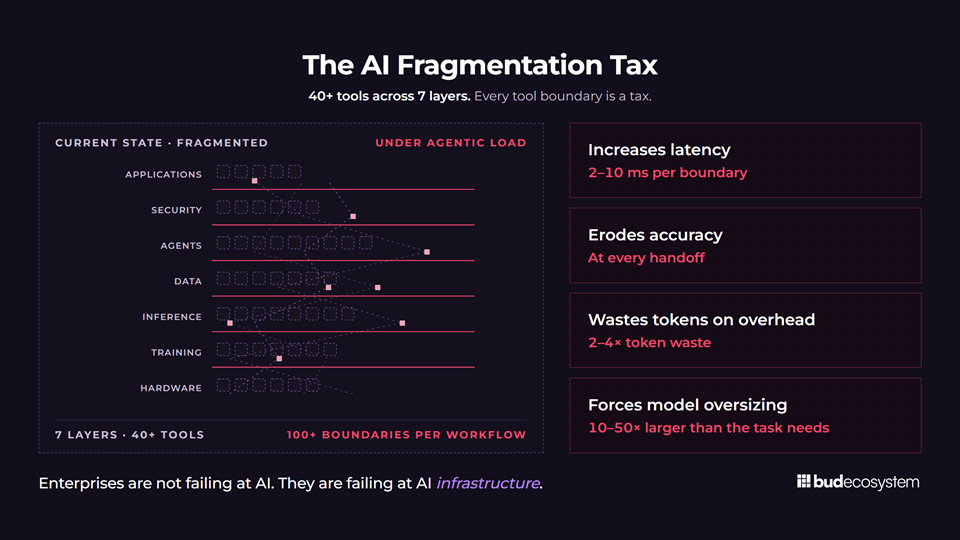
That lesson is my motivation to help build Bud Ecosystem into a world-class enterprise inventing next-generation AI. Generative AI and Agentic AI are now giving enterprises remarkable new capabilities, but they have also handed them a complicated organization and operations problem. A promising AI model still needs infrastructure, trusted data, evaluation, deployment, security, orchestration and support. Those pieces often come from different places across an organization. The challenge is that the customer is left to make them work as one system.
I have seen how quickly a pilot can win attention and how much harder it is to turn that pilot into a service the business can rely on. My work as Bud’s COO sits in that gap. I want our research and engineering to invent products that customers and partners can easily deploy, operate and improve, with realized business results.
We began with the whole system in mind
Bud began as a research-driven company with a simple ambition: make advanced AI practical at scale for any organization. Our teams in India and the United States work across the horizon of data, models, training, inference, security, agents, design and deployment to build value. We learned that improving one layer helps, but a customer expects to experience a workflow transformation, not a point offering. A faster inference engine loses much of its value if the application around it is difficult to integrate, expensive to run or impossible to audit.
By 2025, our research had become a broad portfolio that customers and partners could put to work. That thinking shaped Bud AI Foundry, bringing model deployment, routing, governance and observability into a common operating plane. Our focus shifted to making each release a product that could be packaged, supported and deployed cohesively. As enterprises moved toward agents that use tools and take action, we added Bud Agent technologies. [4] To round this out, in September 2026, we launched the Bud Novaria AI Operating System to bring the comprehensive capabilities together from infrastructure through agents. [1]
A product launch is an important milestone. For me, it also starts a more demanding phase: making the architecture repeatable for customers with different hardware, different data boundaries, and vastly different workflow demands.
The right AI should run in the right place
My background in technologies at scale influences how I think about economics. Enterprises already own substantial infrastructure: CPUs, GPUs, data centers and cloud commitments. Some workloads need high-end GPUs or a frontier model capability, yet many routine requests can be served by a smaller, domain-tuned model. We built the Bud Novaria AI OS to give customers a choice across hardware and models, across on-premise and cloud, and then make placement and routing decisions according to quality, latency, policy and cost. This is a more useful consideration than asking which single model or accelerator should power everything. [2]
It also matters where data goes. A global company may need one deployment pattern for a customer-facing application and another for regulated records. A sovereign program may have to operate inside an air-gapped environment. A serious platform has to respect those boundaries in its architecture and in its day-to-day operations, not just in a presentation.
The customer outcome is the measure
One of our publicly described deployments makes the economic point tangible. A global fashion brand moved a customer-facing styling agent from a frontier-model stack to a Bud domain-tuned small model served on existing Intel Xeon infrastructure. The monthly AI run rate fell from $218,000 to $40,000, while measured accuracy remained effectively level (85.46% before, 85.44% after). Response time fell from about 20 seconds to 6 seconds. The result was delivered by Bud AI Foundry. [1]
A global fashion brand's customer-facing styling agent, moved to a Bud domain-tuned small model on existing Intel Xeon infrastructure
A different deployment shows why this work goes beyond cost. Bud has described a national tax authority operating agentic AI for more than 60,000 concurrent users inside a fully air-gapped environment, with zero data egress. There, the ability to run within the required boundary is central to the outcome. [1]
These cases are meaningful because they connect the technical decisions to something an executive can evaluate: cost per useful outcome, response time, accuracy and trusted control of data. They also show why our engineering, operations, partners and customer teams have to move together. A benchmark alone cannot deliver a production service.
A benchmark alone cannot deliver a production service.
What I want Bud to contribute
We are still early in the industry’s move from isolated AI projects to an AI operating model. I believe Bud can materially elevate the buying discussion from capacity to the outcomes of a governed workflow. Open model choice, heterogeneous compute and a common operating layer give enterprises room to adapt as technology changes. We work with infrastructure partners to bring that choice forward into deployments. [3] We have also open-sourced more than 20 models and joined the Open Platform for Enterprise AI (OPEA) to advance the open ecosystem alongside our commercial products. [5]
I am proud of what our team has built, and I am equally focused on what it takes to earn trust from each customer: clear product commitments, honest measurements, dependable support and the discipline to improve what customers use every day. That is how innovation becomes an operating advantage. It is also the standard I want us to be held to.
If your organization is considering its next AI investment, start with a real workflow, the infrastructure and data you have, and a measurable definition of success. Bring those to Bud. We will prove to you what our platform can do and work with you to determine whether it meets that standard.
Your workflow, the infrastructure and data you already have, and a measurable definition of success.
Sources: [1] Bud Ecosystem, Bud Novaria launch announcement and production examples. [2] Bud Ecosystem, enterprise AI platform overview. [3] Bud Ecosystem, Bud and AMD Instinct ecosystem collaboration. [4] Bud Ecosystem, Bud Agent launch announcement. [5] Bud Ecosystem, Bud joins the Open Platform for Enterprise AI. Deployment figures are as published in the Bud Novaria launch announcement.
 Kevin Johnson
 Rob Rollinger