Every enterprise deploying generative AI eventually arrives at the same uncomfortable realisation: the world's best pre-built guardrails are still written by someone else, for someone else's rules.
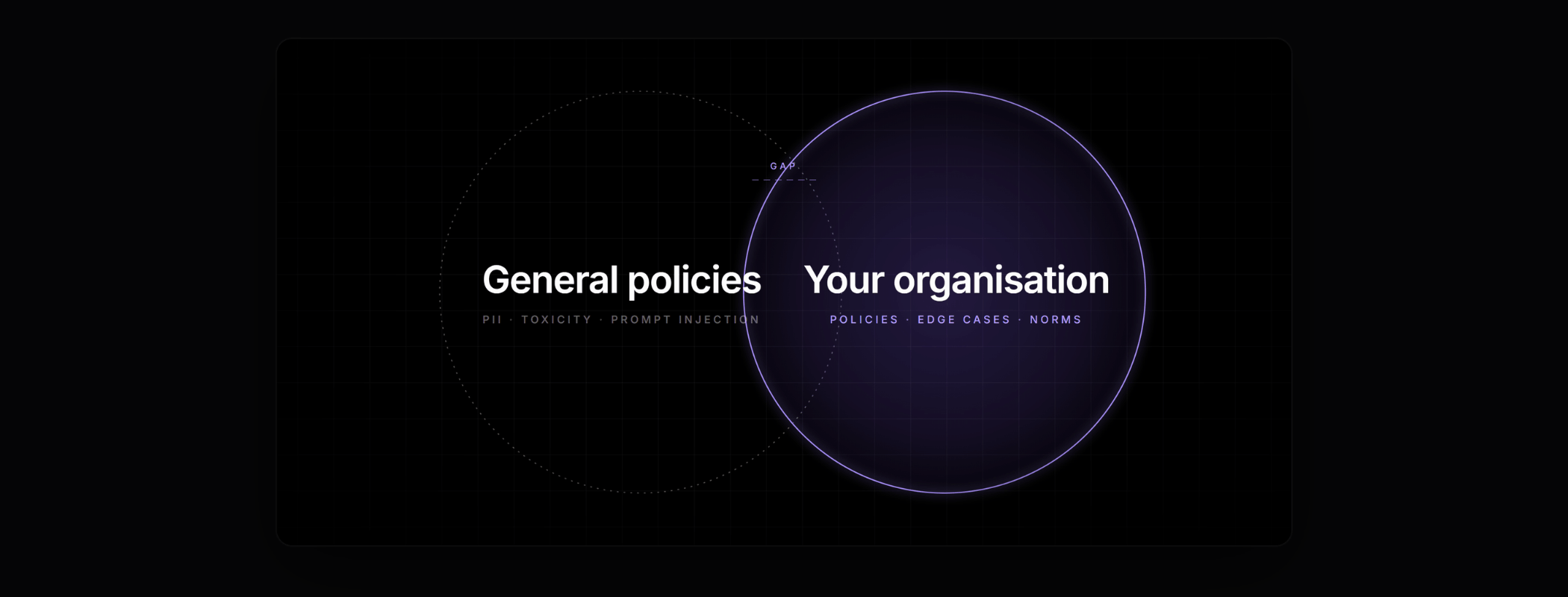
Out-of-the-box safety layers do an admirable job on the universal hazards — profanity, personally identifiable information, prompt injection patterns, clearly toxic content, explicit refusals of hate speech. These are table stakes, and the incumbent providers handle them well. But "toxic in general" and "unsafe for us" are two very different problems. The moment an AI system starts handling real enterprise work — employee conversations, customer escalations, regulated transactions, clinical triage, financial advice, legal intake — the interesting risks stop being universal. They become specific. They become yours.
And that is precisely where generic guardrails have nothing useful to say. Every organisation has its own definition of what is acceptable, its own escalation paths, its own regulatory perimeter, its own list of words legal has quietly banned from customer-facing copy, its own edge cases that only reveal themselves after the third production incident. No pre-trained safety classifier — no matter how sophisticated — can know any of that. It was not in their training data. It is not in their policy library. It never will be.
For serious enterprise AI, the question is not whether you need custom guardrails. It is how you can possibly afford to build them.
Why organisation-specific guardrails are non-negotiable
To see why custom policies matter, it helps to move away from abstractions and look at what actually happens inside a deployed AI system.
The HR agent. Imagine you have rolled out an internal HR assistant. An employee opens a chat and, haltingly, starts describing a harassment incident at work. This is profoundly sensitive territory — the kind of conversation where getting the response wrong is not just a product quality issue but a human, legal, and reputational one. The AI should not attempt to handle this on its own. It should recognise what is happening and immediately route the conversation to a human HR partner, with the appropriate confidentiality and duty-of-care framing. A generic toxicity classifier will not catch this. The employee's language is not toxic. It is vulnerable. That is a domain-specific signal that only your HR policy knows how to read.
The financial services copilot. An internal assistant at a wealth management firm is asked by a customer-facing advisor to "give me a recommendation for this client's portfolio." In most regulatory regimes, an unvetted AI recommendation crossing into an advised client interaction is a suitability issue, not a content issue. The words are perfectly polite. The risk is structural. Only a custom policy — one that encodes your firm's definition of what constitutes advice, for which client types, and under which supervisory arrangements — can catch it.
The healthcare triage assistant. A patient describes symptoms that, in your clinical protocol, constitute a red flag requiring immediate human clinician review. The AI must not reassure, must not triage to a later appointment, must not continue the conversation. It must hand off. The words that trigger this behaviour are clinical, context-dependent, and specific to how your organisation has chosen to interpret its duty of care. An off-the-shelf medical safety filter will not know your protocol.
The legal intake bot. A user on a law firm's website asks a nuanced procedural question. Your professional-responsibility framework draws a hard line between general information and legal advice, and the line sits in a different place than the general-purpose "do not give legal advice" rules a public model has been trained on. Your probe has to enforce your line, not someone else's.
The customer support agent. Your support assistant is authorised to offer a 10% goodwill credit, but not a 30% one. It can mention the existence of your premium tier, but not compare your pricing to a named competitor. It can acknowledge a known outage, but only once the incident has been publicly disclosed. These are not safety issues in the conventional sense. They are operational policy. And yet, the moment any of them are violated, the business takes real damage.
The procurement and manufacturing assistant. An engineer asks for recommended operating parameters for a piece of equipment. Your internal safety protocol permits a narrower range than the manufacturer's public spec sheet. A generic assistant will happily regurgitate the manufacturer's numbers. A correct one will enforce your plant's conservative envelope.
The words on the screen are not the risk. The context is. The policy is. The organisation is. And no pre-trained guardrail has ever heard of your organisation.
The hidden tax on enterprise guardrails today
Teams that have tried to build custom guardrail coverage know the problem is not that the need is unclear. It is that the available paths to meet that need are each, in their own way, punishing. There are three taxes, and they compound.
- The cost tax. Guardrails run on every input, every output, and — in agentic systems — every intermediate action. The guardrail layer is, effectively, a shadow inference pipeline running in parallel to the primary one. In practice this has a habit of quietly becoming one of the largest line items in an AI programme's budget. Teams discover, months after shipping, that their guardrail costs are comparable to their primary model costs — sometimes higher, especially when multiple probes are stacked for defence in depth. The economics are particularly painful for high-volume, low-margin use cases like customer support, where every cent of per-interaction cost translates directly into a business case that does or does not work.
- The model training tax. The traditional way to encode organisation-specific rules is to train your own classifier. That requires labelled training data in the thousands of examples, often tens of thousands for anything nuanced; an evaluation harness sophisticated enough to catch regressions; MLOps infrastructure for training, versioning, deploying, monitoring and rolling back; ML engineering and applied research talent, the scarcest in the market; and iteration cycles, because nobody gets a guardrail model right first time. Most enterprises do not have these capabilities in-house and cannot acquire them at the speed their AI roadmaps demand.
- The time tax. By the time a custom classifier is labelled, trained, evaluated, and signed off by safety and compliance, the underlying policy has often moved. A new regulation has dropped. A legal decision has reshaped what "appropriate advice" means in your jurisdiction. Your HR team has expanded their definition of escalation-worthy conduct. Safety that ships six months after it was needed is not safety — it is a liability dressed in the language of diligence.
Custom guardrail models get built by the few, while the many deploy AI with coverage they know to be incomplete — and hope.
That is not a sustainable risk posture.
The shape of a better answer
Step back from the specifics, and the nature of the problem comes into focus. Enterprises do not actually need the ability to train custom models. They need the ability to express custom policies. The model is incidental — a means to an end. What the business actually has, and needs to encode, is judgement: definitions, interpretation rules, examples of what is safe and what is not, an explicit position on ambiguity.
That is not a machine learning artefact. That is a policy document. If a system could read a well-written policy document and enforce it at inference time — with the same nuance and edge-case reasoning that a human reviewer would apply — the entire problem structure changes. The cost tax shrinks, because you are no longer running a second model train for every new policy. The training tax disappears, because there is no training. The time tax collapses, because the distance from "policy decision" to "enforced behaviour" is measured in minutes, not quarters.
How Bud AI Foundry changes the equation
Bud AI Foundry treats guardrails as a first-class capability of the platform rather than a side accessory bolted onto inference. Two design decisions, in particular, matter for the custom-policy problem.
The first is Bud Sentinel, the enforcement layer that runs guardrail policies at inference time. Sentinel is engineered specifically for the economics of production AI. Built on Resource Aware Attention, it runs all 23 guardrail models on commodity CPUs with state-of-the-art accuracy, clocking 8.39 ms on a laptop CPU against roughly 18 to 19 ms for competing models running on a $15,000 A100. The cost maths shifts just as sharply: CPU cloud instances run at around $0.50 per hour versus $2 to $3 per hour for A100 instances, producing a 15 to 18× cost-performance advantage and bringing the unit economics down to about $0.10 per million classifications.
There is no GPU procurement, no cluster management, and no infrastructure refresh required, and the same binary deploys cleanly into public cloud, on-prem, air-gapped, and edge environments. The net effect is that guardrails stop being a cost centre organisations ration across their most sensitive workflows and become ambient infrastructure that can run on every agent action, every tool call, and every model output without a GPU ever entering the loop. For teams that have been rationing coverage in the name of unit economics, defence in depth stops being a luxury.
The second is custom probe creation without model training. This is the change that resolves the training tax and the time tax together. Instead of handing your policy to an ML team and waiting, you encode the policy directly — in natural language, with structured fields designed to capture exactly the kind of judgement a human reviewer would bring to a borderline case. The probe reasons over your policy at inference time. No labelled dataset. No training run. No MLOps pipeline. No waiting.
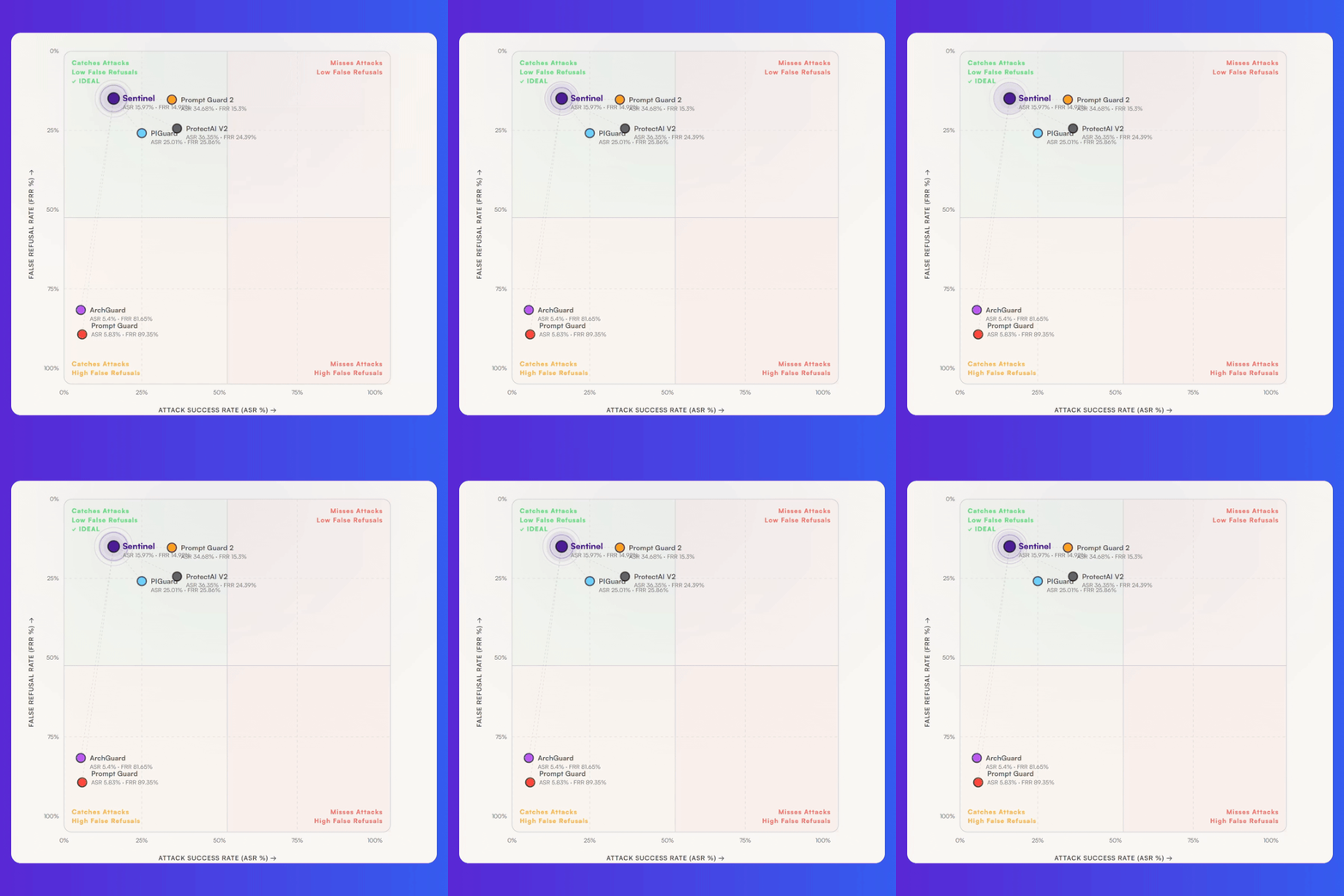
The effect is to move guardrail creation from an engineering project to a policy-authoring exercise. The people best positioned to define what is acceptable — your compliance officer, your HR lead, your head of clinical operations, your customer experience director — can actually express that definition themselves, rather than translating it through a game of telephone that ends at a data labelling spreadsheet. This is a meaningful shift in who owns AI safety inside the enterprise. It stops being a bottleneck inside the ML team.
Walking through a custom probe, end to end
To make this concrete, consider the HR harassment scenario from the beginning of this article. From the Bud AI Foundry dashboard, you navigate into the Guardrails module and click Add Guardrail, then Create Custom Probe. The flow is deliberately designed around how a human policy author actually thinks — definitions first, then interpretation, then examples, then ambiguity handling.
Task description
The first field is a plain-language statement of what this probe exists to catch. For the HR scenario, it might describe a policy to detect harassment incidents surfaced by employees during an AI-mediated interaction, and ensure such cases are routed for human handling rather than answered by the agent. The point of this field is not decoration. It is the north star that every other field should align with. A sharp task description is the difference between a probe that protects your users and a probe that drifts over time.
Definitions
Next is the vocabulary of your domain — domain-specific abbreviations, internal terminology, your policy-specific interpretations of loaded words. This matters more than it looks. Without explicit definitions, the probe falls back on whatever general-purpose meaning the underlying model has learned from the public internet. "Harassment," in a legal policy sense, has a different shape than "harassment" as used in everyday speech. "Hostile work environment" has a precise legal threshold that differs from colloquial usage. If you want the probe to apply your organisation's interpretation, those interpretations need to be stated. Otherwise the probe is, in effect, enforcing someone else's policy by accident.
Interpretation rules
These are the conditional logic statements that tell the probe when to fire and when to hold back. For an HR probe, an interpretation rule might capture the distinction between an employee raising a live incident versus an employee asking a procedural question about company policy. Both conversations contain the word "harassment." Only one of them represents an active escalation that needs a human. Interpretation rules are how you make that distinction explicit, rather than leaving it to the probe's instincts.
Evaluation approach: depiction, request, guidance
This is the probe's reasoning lens, and three sub-fields work together. Depiction tells the probe what kind of content it is looking at — employee message, model output, agent-initiated action — so it approaches the content with the right framing. Request tells the probe what specific question to answer about that content: not "is this bad?" but a precise, narrow question anchored in your policy. Guidance provides the reasoning framework the probe should apply at inference time — the chain of considerations a careful human reviewer would walk through when adjudicating a borderline case.
The combination gives the probe a consistent lens. Every case gets examined with the same intent, using the same question, applying the same reasoning approach. That consistency is what separates a defensible guardrail from a coin flip.
Safe content
It is tempting, when building a safety probe, to focus entirely on violations. This is almost always a mistake. A probe that over-blocks is its own category of failure. An HR assistant that refuses to answer a benign question about company anti-harassment policy because it spotted the word "harassment" has stopped being useful. Worse, it has trained employees to stop trusting the tool. Over time, they route around it. That is a safety failure dressed up as safety success.
Explicitly defining the safe content types — the cases that contain the policy's key terms but are not themselves violations — prevents this drift. A casual policy question is safe content. A manager asking about training materials is safe content. Defining these cases as clearly as the violations is what gives the probe real discrimination.
Training examples
The probe sharpens on labelled examples. A working minimum is around five, but seven or more — especially covering the edge cases your specific deployment will encounter — is materially better. Crucially, these are not a training dataset in the machine-learning sense. No gradient descent happens. Instead, the examples serve as illustrations the probe reasons with at inference time — concrete anchors that demonstrate how to think about a case, particularly the boundary cases where reasonable people might disagree. This is the single largest practical difference between training a classifier and authoring a probe: one requires thousands of labelled rows and a data pipeline, the other a handful of carefully chosen examples that capture real-world nuance.
Violations, organised by severity
Violations are grouped by severity so that downstream systems can respond proportionally. A low-severity policy drift should not be handled the same way as a live harassment report. Severity stratification lets the rest of your stack act intelligently: a soft warning for the minor case, immediate human handoff for the serious one, a policy-specific escalation path for everything in between.
Ambiguity handling
Finally, you tell the probe exactly what to do when a case does not fall cleanly into safe or violating territory. Real production traffic lives in the grey zone. A probe with no explicit ambiguity rule will either freeze on uncertain cases or default to whatever implicit bias the underlying model happens to have. Neither is acceptable for enterprise use. Explicit ambiguity handling lets you state your organisation's position: default conservative, route to a human, apply a specific combination rule, allow with a flag.
A 30-minute walkthrough on your hardware mix, governance constraints, and top use case.
What this unlocks, in practice
- Safety becomes a product of the business, not the ML team. The people who understand your policies best are now the people encoding them. That shortens feedback loops, reduces translation errors, and makes AI safety an ongoing collaboration rather than a quarterly hand-off.
- Defence in depth becomes economically viable. When each new probe does not require training, labelling, or infrastructure, the marginal cost of adding another layer of coverage falls dramatically. Teams can afford multiple probes per interaction without breaking the unit economics of the product.
- Policy can move as fast as the business. When a new regulation drops, or a legal review changes a definition, you update the probe the same week — not the next fiscal cycle.
- The long tail becomes addressable. Most enterprise AI risk lives in the long tail of domain-specific edge cases no off-the-shelf classifier will cover. When the authoring cost drops to the cost of writing a good policy document, the long tail becomes something you can actually close.
- Ownership becomes clear. A probe with an explicit task description, definitions, interpretation rules, and named ownership is auditable in a way a black-box classifier never was. Compliance teams can read the probe. Internal audit can trace a production behaviour back to the specific rule that produced it.
From safety as a model problem to safety as a policy problem
There is a quiet but important rethinking embedded in all of this. For the better part of a decade, "AI safety" has been treated primarily as a modelling problem. Train better classifiers. Collect more labelled data. Build more sophisticated red-team evaluations. The answer to a new risk was always the same: train another model.
That framing made sense when the AI systems in question were narrow, when the risks were well understood, and when the organisations building them were AI labs with deep ML benches. It makes much less sense in the enterprise context, where the systems are horizontal, the risks are domain-specific, and the organisations deploying AI are banks and hospitals and manufacturers whose core competency is not model training.
In this world, the binding constraint is not modelling capability. It is the ability to express nuanced, domain-specific policy at the speed and cost that the business actually operates on. Safety becomes a policy artefact. The policy becomes executable. The executable policy runs cheaply enough to cover the whole surface area of the deployment. None of those changes, on their own, are revolutionary. Together, they redraw the economics of responsible AI deployment.
Closing: AI safety that fits
Every enterprise deploying AI eventually has to answer the same question: does your safety layer actually encode your organisation's judgement, or does it encode someone else's, with your logo on it?
Off-the-shelf guardrails will always have a role. Universal hazards demand universal coverage, and the incumbents do that well. But the risks that actually threaten an enterprise — the HR escalation that was not recognised, the financial recommendation that crossed a regulatory line, the brand-damaging customer interaction that slipped through because the policy had never been encoded anywhere a machine could read it — those risks are yours. They need safety that is also yours.
Sentinel addresses the cost problem that has quietly been holding enterprise guardrail coverage back. Custom probe creation without model training addresses the capability and speed problems that have kept custom policies out of reach for most organisations. Together, they let enterprises build AI safety that actually fits — defined by the people who know the policy, running at an economic profile that makes comprehensive coverage viable, and updatable at the pace the business actually moves.
In the next article in this series, we will look at how to monitor probe results in production, interpret the signals they surface, and tune your policies over time — because good guardrails, like good policy, are never a one-off decision.
Frequently asked questions
Why aren't off-the-shelf AI guardrails enough for enterprises?
Pre-built guardrails handle universal hazards well — profanity, PII, prompt injection, clearly toxic content. But the risks that actually threaten an enterprise are organisation-specific. An HR assistant needs to recognise a harassment escalation and route it to a human. A wealth management copilot needs to know where your firm draws the line between information and regulated advice. None of these are content problems a generic toxicity classifier can catch. The words on the screen are not the risk; the context, the policy, and the organisation are.
Can you build custom AI guardrails without training a machine learning model?
Yes. The traditional approach required thousands of labelled examples, an evaluation harness, MLOps infrastructure, scarce ML talent, and multiple iteration cycles. Custom probe authoring replaces that pipeline: you encode your policy directly in natural language using structured fields — task description, definitions, interpretation rules, evaluation approach, safe content, examples, severity-tiered violations, ambiguity handling. The probe reasons over your policy at inference time. No labelled dataset, no training run, no MLOps pipeline.
Why is CPU inference cheaper than GPU for guardrails?
Guardrails run on every input, every output, and every intermediate agent action, effectively a shadow inference pipeline alongside the primary model. Sentinel addresses this with Resource Aware Attention, running all 23 guardrail models on commodity CPUs at 8.39 ms on a laptop CPU compared to roughly 18 to 19 ms for competing models on a $15,000 A100. CPU cloud instances run around $0.50 per hour versus $2 to $3 for A100s — a 15 to 18× cost-performance advantage, and roughly $0.10 per million classifications.
What fields go into creating a custom probe?
Eight structured fields, ordered the way a human policy author actually thinks: task description, definitions, interpretation rules, the three-part evaluation approach (depiction, request, guidance), safe content, training examples, severity-organised violations, and ambiguity handling.
How quickly can policies be updated when regulations change?
With traditional custom-classifier workflows, updates take months, and by the time one ships the underlying policy has often moved on. With probe authoring, the distance from policy decision to enforced behaviour is measured in minutes. When a regulation changes or an incident review produces a new interpretation rule, the probe is updated the same week.
- Generic guardrails catch universal hazards; the risks that threaten an enterprise are specific to it.
- Three taxes — cost, training, and time — are what keep custom policies out of reach.
- Authoring a policy the probe reasons over at inference time removes all three.
Sentinel performance and cost figures are Bud's own measurements: 8.39 ms on a laptop CPU, roughly 18–19 ms for competing models on an A100, and approximately $0.10 per million classifications. Instance pricing ranges are indicative market rates at the time of writing and vary by cloud, region, and commitment. The scenarios in the opening section are illustrative composites, not customer deployments.